Loop Engineering Patterns: Daily Triage to CI Sweeper
Seven production loop patterns with concrete Souso (smart-cart) scenarios, cadences, and risk levels

Nicolás Torres
You have a working L1 loop on Souso. Now what else can you build? Seven production patterns cover most real-world needs, from safe morning reports to dangerous CI auto-fix. Each one below includes a Souso vignette so the pattern isn't abstract.
Pattern names, cadences, risk levels, and the L0–L3 rollout come from Cobus Greyling's loop-engineering repo (MIT). Souso examples are original to this series.
Haven't run the example yet? Post 4 has the clone-and-run walkthrough.
A few terms first
This post assumes you built the Daily Triage loop from the previous article (scan once a day, write to STATE.md, change nothing). If any of the shorthand below is unfamiliar, read this block once:
| Term | Plain meaning |
|---|---|
| CI (continuous integration) | Automated checks on every push or PR: tests, lint, typecheck, build. "CI is red" = something failed. |
| PR (pull request) | A proposed code change on GitHub waiting for review and merge. |
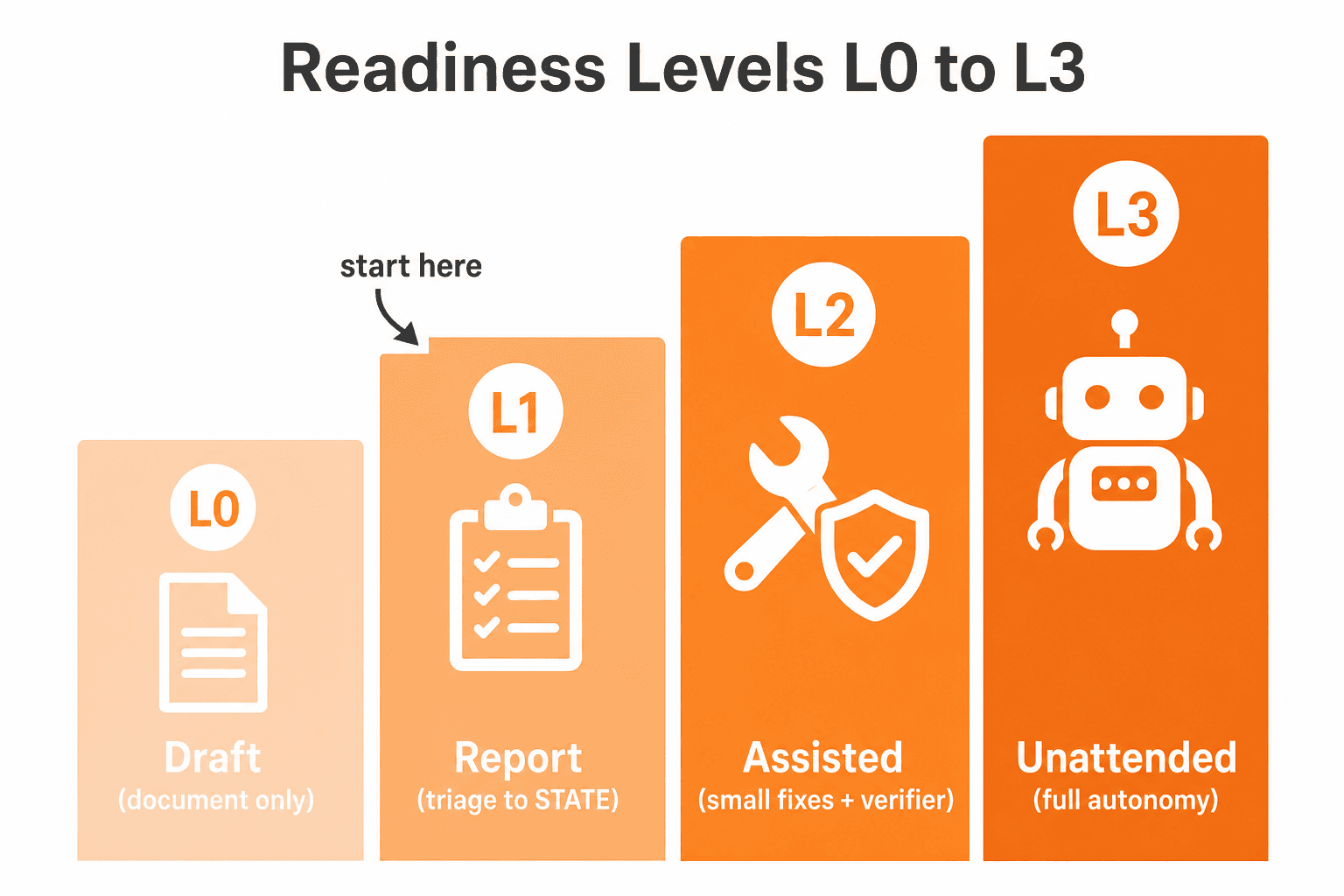
| L1 | Report-only. The loop reads the repo and writes findings. No edits. |
| L2 | Assisted. Small fixes allowed, usually with a verifier or human approval. |
| L3 | Unattended. The loop may change code and open PRs without you watching. |
Patterns 6 and 7 have informal nicknames you will see in ops chat and in the next post:
- PR Babysitter: Checks open PRs every few minutes. Is CI green? Any merge conflicts? Reviews going stale? At L2 it only flags problems; at L3 it may try tiny fixes (lint, typos).
- CI Sweeper: Reacts when CI fails. Read the log, attempt a fix, run tests, open or update a PR. High risk because it writes code on its own.
The full L0–L3 rollout table is at the end of this post.
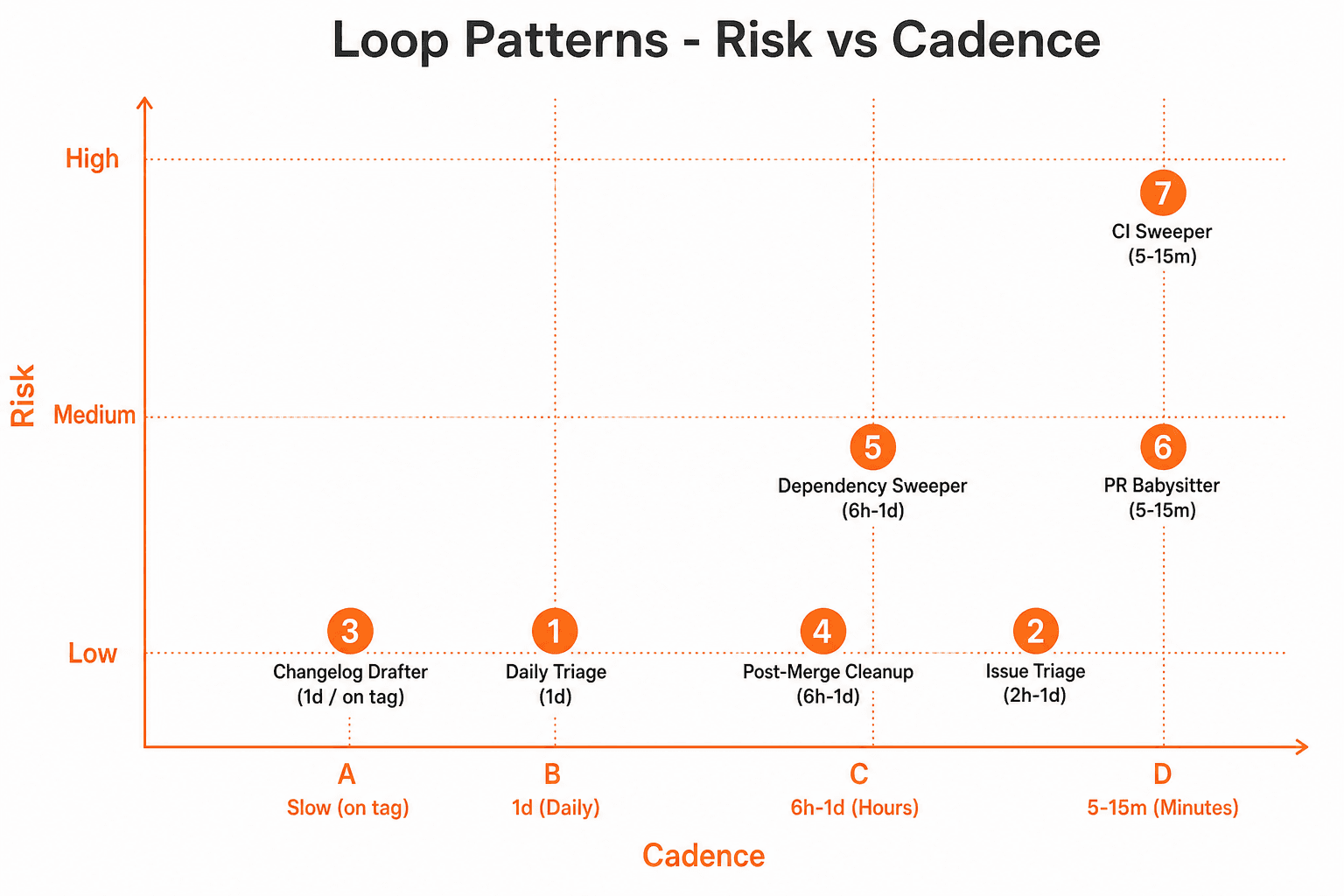
1. Daily Triage (Start Here)
Cadence: 1 day
Risk: Low
Readiness: L1 (report-only)
Every morning, scan open issues, PRs to develop, and CI status. Write structured findings to STATE.md. Change nothing.
Souso example: The loop we built in the previous post. It surfaces #401 (RangeError), #444 (admin UX), and stale PRs waiting on the gate job. ~50k tokens per run.
/loop 1d "Run loop-triage. Update STATE.md. L1: no code changes."2. Issue Triage
Cadence: 2h–1d
Risk: Low
Readiness: L1 (propose-only)
Focus on new and unlabeled issues. Suggest labels, flag duplicates, propose assignees. Human approves before any label is applied.
Souso example: #528 Ingredient replacement arrived unlabeled. Issue Triage proposes enhancement + needs-scope and flags it Waiting on Human until product confirms scope. Souso already uses ready-for-agent, bug, and other labels. This loop keeps the queue clean.
3. Changelog Drafter
Cadence: 1d or on tag
Risk: Low
Readiness: L1 (draft)
Scan merged PRs and draft a changelog entry. No code changes; worst case is a messy draft you edit.
Souso example: Souso promotes develop → main for prod deploys. After a promotion PR merges, the loop drafts a changelog from the commit range: new week-menu features, cart pricing fixes, admin updates. Draft goes to a file or GitHub Release draft.
4. Post-Merge Cleanup
Cadence: 6h–1d (off-peak)
Risk: Low
Readiness: L1 → L2
Remove stale feature flags, delete merged branches, address TODO comments introduced in recent merges.
Souso example: After shipping a week-menu feature, a VITE_SHOW_NEW_WEEK_UI flag might still be true in code. Post-merge cleanup at 22:00 removes it off-peak so it doesn't collide with active develop PRs.
5. Dependency Sweeper
Cadence: 6h–1d
Risk: Medium
Readiness: L2 (patch-only)
Check for outdated or vulnerable dependencies. Patch bumps only; minor/major escalates to human.
Souso example: Souso runs on Cloudflare Workers with TanStack Start, Drizzle, and React 19. A patch bump to wrangler or vitest might be safe; a major React bump is never auto-merged. Workers compat and SSR behaviour need human review.
6. PR Babysitter (watch open PRs)
Cadence: 5–15 min
Risk: Medium
Readiness: L2 (watch) → L3 (fix)
Think of a babysitter for your pull requests: something that keeps an eye on them while you are in meetings. Each run asks: Did CI pass? Is there a merge conflict with develop? Has this PR sat idle too long? At L2 it only writes alerts (to STATE.md or Slack). At L3 it may push a small fix and re-run CI.
Souso example: A PR into develop fails the gate job (pnpm quality). Babysitter investigates: is it a lint error (maybe fixable) or a matcher eval regression (escalate, owned flow)? Early exit if no PRs need attention, under 5k tokens.
Critical: Hard-cap at 3 fix attempts. Souso's active develop branch can have multiple PRs. A 5-minute cadence with full sub-agent chains burns tokens fast.
7. CI Sweeper (fix red CI)
Cadence: 5–15 min
Risk: High
Readiness: L3 (cautious)
A sweeper cleans up messes. When CI turns red (a test fails, lint breaks, build errors), this loop investigates the failure, tries a fix, runs the same checks locally, and opens or updates a PR. You are not in the loop unless it escalates. That is why it is L3-only on most teams: one wrong guess can ship a bad patch.
Souso example: Matcher eval fails after a pricing change. Sweeper might fix a golden test case. But #401 RangeError on /week is not a sweeper job: root cause is unknown, reproduce-first is required, and the week generation flow is ownership-sensitive. Sweeper escalates, never guesses.
Mandatory safeguards on Souso:
- Verifier runs
pnpm quality, not just unit tests - Never disable evals to make CI green
- Never auto-edit
src/lib/pricing/*without human review - 3 attempts → human
Which Pattern to Run First?
- Daily Triage at L1: run for a week on Souso (done in post 4)
- Add Issue Triage or Changelog Drafter: cheap, no risk
- PR Babysitter or Dependency Sweeper at L2 when L1 is accurate
- CI Sweeper only after robust verification and explicit approval
Souso rule: Never L3 on owned AI flows (src/lib/pricing/*, week generation, replan internals) without ownership review. The ship-flow-and-ownership skill exists for a reason.
The Phased Rollout
| Level | Description | What's enabled |
|---|---|---|
| L0: Draft | Documented intent only | LOOP.md, no automation |
| L1: Report | Triage → state, no auto-action | Daily Triage (Souso today) |
| L2: Assisted | Small fixes + verifier | PRs for allowlisted paths |
| L3: Unattended | Runs without you watching | CI Sweeper, full autonomy |
Never skip L1 on a production repo. One week of report-only tells you more than a month of guessing.
Sources: Addy Osmani's Loop Engineering. Seven patterns and L1–L3 rollout from Cobus Greyling's loop-engineering repo (MIT). Cobus Greyling's Loop Engineering essay.